The effet tetris (French: Tetris effect) is a similarly named, but quite different phenomenon found in evolutionary AI systems. In the game of Tetris the player has two demands on his attention -- the choice of an optimal placement for the new piece and the ability to manoeuvre that piece in the time alloted. The effet tetris then, is the effect whereby a hasty, but imprecise course of action is better than calculating an optimal move where such a calculation would not be completed in time; in short, evolutionary systems often find local rather than global optima.
L'effet Tetris (ou stratégie Tetris) est un exemple d'application de la sélection naturelle dans le domaine de l'intelligence artificielle. Il tire son nom du jeu vidéo Tetris, où le joueur doit décider rapidement de la meilleure façon de placer des pièces défilant à une vitesse toujours croissante. Il y a donc deux facteurs à prendre en compte : la pertinence du choix de placement, et la vitesse de prise de décision.
L'effet Tetris désigne le fait qu'une perception hâtive occasionnellement fausse peut se montrer plus efficace qu'une analyse exacte dont le résultat serait venu trop tard. Par exemple, c'est le cas lorsque le coût de l'erreur est faible quand elle se fait d'un côté, et grand quand elle se fait de l'autre. Quand l'objectif est la simple survie, il est donc parfois plus rentable de choisir une solution simplement « assez correcte » plutôt que de rechercher en y consacrant beaucoup d'énergie et de temps la meilleure solution.
Ce principe de sélection se retrouve dans des algorithmes et les heuristiques employés en intelligence artificielle.
Remarque
Attention, le sens anglais (Tetris effect) diffère du sens français ; il désigne la façon dont une activité à quoi on consacre suffisamment de temps et d'attention peut dominer de façon obsessionnelle les pensées, les représentations mentales et les rêves.
Autres articles
Rationalité limitée
Élagage alpha-beta
Data mining
Monday, 3 May 2010


Tetris Effect - II
The Tetris effect can occur with other video games, with any prolonged visual task (such as classifying cells on microscope slides, weeding, picking or sorting fruit, flipping burgers, driving long distances, or playing chess or cards), and in other sensory modalities. For example, there is the tendency for a catchy tune to play out unbidden in one's mind (an earworm). In kinesthesis, a person newly on land after spending long periods at sea may move with an unbidden rocking motion, having become accustomed to the ship making such movements (known as sea legs or mal de debarquement). Computer programmers and developers sometimes have similar experiences, and report dreaming about code when they sleep at night, and return to work the next day feeling like they had never left. People have also experienced this effect after playing music games with scrolling notes, such as Guitar Hero, Dance Dance Revolution, Rock Band, or beatmania IIDX. Fans of the game Polarium have had images of tiles being overturned in their mind, or feeling as though they needed to be overturned. After playing bullet hell games, many players have reported that looking at small objects, such as letters on the page of a book, appear to be moving around or swirling in patterns. Also the Rubik's Cube may make a person imagine turning the sides and the colours in their minds after playing it for a prolonged period of time.
Place in memory
Stickgold et al. (2000) have proposed that Tetris imagery is a separate form of memory, likely related to procedural memory. This is from their research in which they showed that people with anterograde amnesia, unable to form new declarative memories, reported dreaming of falling shapes after playing Tetris during the day, despite not being able to remember playing the game at all. A recent Oxford study (2009) suggests Tetris-like video games may help prevent the development of traumatic memories. If the video game treatment is played soon after the traumatic event, the preoccupation with Tetris shapes is enough to prevent the mental recitation of traumatic images, thereby decreasing the accuracy, intensity, and frequency of traumatic reminders. "We suggest it specifically interferes with the way sensory memories are laid down in the period after trauma and thus reduces the number of flashbacks that are experienced afterwards," summarizes Dr. Emily Holmes, who led the study.
History of the term
According to Earling (1996), one of the first references to the term is by Garth Kidd in February, 1996. Kidd described "after-images of the game for up to days afterwards" and "a tendency to identify everything in the world as being made of four squares and attempt to determine 'where it fits in'". Kidd attributed the origin of the term to computer-game players from Adelaide, Australia.
Source:
http://en.wikipedia.org/wiki/Tetris_effect
Place in memory
Stickgold et al. (2000) have proposed that Tetris imagery is a separate form of memory, likely related to procedural memory. This is from their research in which they showed that people with anterograde amnesia, unable to form new declarative memories, reported dreaming of falling shapes after playing Tetris during the day, despite not being able to remember playing the game at all. A recent Oxford study (2009) suggests Tetris-like video games may help prevent the development of traumatic memories. If the video game treatment is played soon after the traumatic event, the preoccupation with Tetris shapes is enough to prevent the mental recitation of traumatic images, thereby decreasing the accuracy, intensity, and frequency of traumatic reminders. "We suggest it specifically interferes with the way sensory memories are laid down in the period after trauma and thus reduces the number of flashbacks that are experienced afterwards," summarizes Dr. Emily Holmes, who led the study.
History of the term
According to Earling (1996), one of the first references to the term is by Garth Kidd in February, 1996. Kidd described "after-images of the game for up to days afterwards" and "a tendency to identify everything in the world as being made of four squares and attempt to determine 'where it fits in'". Kidd attributed the origin of the term to computer-game players from Adelaide, Australia.
Source:
http://en.wikipedia.org/wiki/Tetris_effect
El efecto tetris es la habilidad de cualquier actividad, a la que una persona haya dedicado suficiente tiempo, de controlar los pensamientos, imágenes mentales y sueños del individuo. El nombre del efecto proviene del juego tetris, en el que el jugador debe rotar y mover bloques con diferentes formas mientras caen. Si el jugador puede acomodar los bloques para que formen una línea horizontal completa, esta desaparecerá. El objetivo principal es evitar que los bloques llenen toda la pantalla. Gente que juega al tetris por mucho tiempo, se da cuenta que termina pensando como acomodar diferentes formas que se encuentra en el mundo real, como por ejemplo edificios o baldosas. En este sentido, el juego del tetris es como una forma de hábito. También estas personas pueden ver formas cayendo en los costados de su campo visual, en lo que se llama visión periférica, o también al cerrar los ojos. En este sentido, el efecto es una forma de alucinación.
http://es.wikipedia.org/wiki/Efecto_tetris
http://es.wikipedia.org/wiki/Efecto_tetris
"Korobéiniki" (en ruso: "Коробе́йники", "los buhoneros") es una canción popular rusa, también conocida como Koróbushka.
La canción "Korobéiniki" se basa en un poema del mismo título escrito por Nikolái Nekrásov y publicado en la revista Sovreménnik en 1861.[1] Debido a su ritmo acelerado y al estilo de baile asociado a la canción, pronto se convirtió en una conocida canción popular rusa.
Los korobéiniki (en singular, korobéinik) eran buhoneros que llevaban bandejas con mercancías tales como telas, artículos de mercería, libros y otros artículos de pequeño tamaño en la Rusia prerrevolucionaria. La canción cuenta la historia de un joven korobéinik que intenta vender su mercancía a una chica de ojos oscuros llamada Katia, a la que acaba besando, lo que conduce a ambos a desaparecer en un campo de centeno.
Hirokazu Tanaka escogió esta canción como la música de fondo "Type A" de la versión del videojuego Tetris para la Game Boy.
Fuente:
http://es.wikipedia.org/wiki/Korobeiniki
La canción "Korobéiniki" se basa en un poema del mismo título escrito por Nikolái Nekrásov y publicado en la revista Sovreménnik en 1861.[1] Debido a su ritmo acelerado y al estilo de baile asociado a la canción, pronto se convirtió en una conocida canción popular rusa.
Los korobéiniki (en singular, korobéinik) eran buhoneros que llevaban bandejas con mercancías tales como telas, artículos de mercería, libros y otros artículos de pequeño tamaño en la Rusia prerrevolucionaria. La canción cuenta la historia de un joven korobéinik que intenta vender su mercancía a una chica de ojos oscuros llamada Katia, a la que acaba besando, lo que conduce a ambos a desaparecer en un campo de centeno.
Hirokazu Tanaka escogió esta canción como la música de fondo "Type A" de la versión del videojuego Tetris para la Game Boy.
Fuente:
http://es.wikipedia.org/wiki/Korobeiniki
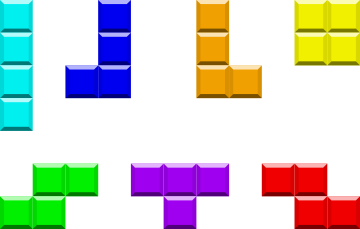
Distintos tetriminos, figuras geométricas compuestas por cuatro bloques cuadrados unidos de forma ortogonal, caen de la parte superior de la pantalla. El jugador no puede impedir esta caída pero puede decidir la rotación de la pieza (0°, 90°, 180°, 270°) y en qué lugar debe caer. Cuando una línea horizontal se completa, esa línea desaparece y todas las piezas que están por encima descienden una posición, liberando espacio de juego y por tanto facilitando la tarea de situar nuevas piezas. La caída de las piezas se acelera progresivamente. El juego acaba cuando las piezas se amontonan hasta salir del área de juego.
Subscribe to:
Posts (Atom)